Showing posts with label church. Show all posts

Thursday, March 18, 2010

Your Review is Too Late

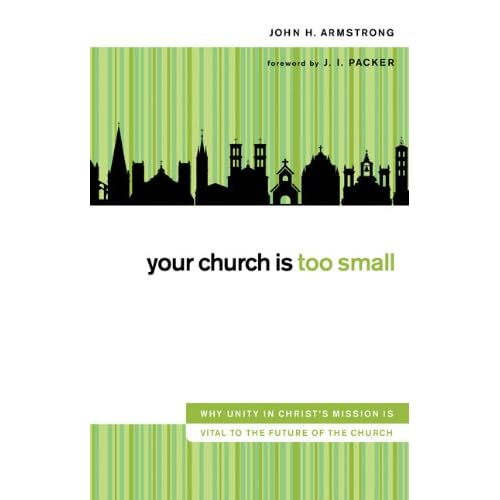
My apologies to those looking here for my review of ‘Your Church is Too Small’ by John H. Armstrong as part of this week’s blog tour. It’s been an unusually busy week of ministry (is there such thing as a usual week?) and therefore no posting is going to make it this week.

I hope to have my review posted soon. In the meantime there should be 74 other posts you can read as part of the blog tour as well as the book’s site www.yourchurchistoosmall.com.

Thanks to my readers and to the folks at Koinonia for your patience and understanding.

Reblog this post [with Zemanta]

Tuesday, January 19, 2010

The State of Evangelicalism?


D.A. Carson: Evangelicalism’s E.F. Hutton

With cup of coffee in hand this morning I treated myself to watching a video of D.A. Carson’s recent lecture at ETS entitled The Changing (Changeless?) Face of Evangelicalism. I don’t exaggerate, it truly is a treat to listen to Dr. Carson speak and to read his books. I had the privilege of sitting under his teaching for one class while I was a seminary student at Trinity Evangelical Divinity School.

Dr. Carson’s lecture, as you can discern from the title, was on the current state of evangelicalism. What does it mean to call oneself an “evangelical”? Is it a label tied to history? Does it define a set of doctrines or convictions? Does it refer to a certain kind of Christian lifestyle? Is it synonymous with “Conservative Christian”?

The video can be viewed or downloaded from The Gospel Coalition website courtesy of Crossway Books. In the meantime I am looking forward to the release of Dr. Carson’s book Evangelicalism: What Is It and Is It Worth Keeping? this September. I imagine this book will do much to further the conversation.

What’s in a name?

I wonder if the term “evangelical” (and its related cognates such as “evangelism”, “evangelist”, etc.) is indeed losing its intended meaning similar to the way the term “fundamentalism” and terms related to it have changed over the years.

Our church was forced to consider this not long before I came to serve as their pastor. For many years the name of our church was “Fundamental Gospel Church”, in fact many in town still refer to it by that name. Today, in large part due to our adoption in to the EFCA denomination, our church is now know as Cornerstone EFC. Our leadership realized that the once positive name “Fundamental” did not communicate the same positive sense that at the time of its founding 50 years prior.

I would encourage you to watch the video and consider what Dr. Carson is saying. What do you think? What is the state of evangelicalism, particularly in America? What do you think the term conveys today; is it positive or negative? I’m looking forward to hearing your comments.

Reblog this post [with Zemanta]

Saturday, January 9, 2010

Don’t Just Listen to the Sermon

Pathfinder Bible Achievement 2008

Image by Vicki's Pics via Flickr

Engaging the Message

My guess is that few people other than the pastor are thinking much about tomorrow’s sermon. In fact most people will probably not begin to think about the sermon until the preacher speaks his first words.

It is the pastor’s responsibility to engage his hearers, but it is also the hearer’s responsibility to engage what he hears. To help my congregation to become more engaged hearers I put together a list of ten suggestions which I called ‘How to Get the Most out of the Message.’

Not everyone will adopt all ten suggestions into their Sunday routine. But making an effort in one or two of these areas to become more engaged before, during, and after the message will go a long way.

I am going to present this list in a series of three posts. Use what you find helpful and be sure to comment with your own practices.

1. Bring your Bible to church.

That may sound like an obvious suggestion. Many people already bring their Bible with them to church. Others will use the pew Bible or will read the text printed in the bulletin or projected on the screen. The reason that we need to bring a Bible with us is so that we are able to see with our own eyes what we are hearing with our ears.

We are not only learning what the Bible says, but we are also being taught how we are to use the Bibles we have. Since the sermons we hear are (hopefully) based on what the text of the Bible says, we need to be able to verify what we hear with what is printed on the page.

2. Take notes during the sermon.

Taking notes is more than just filling in the blanks. In many churches what is provided in the bulletin is merely an outline. On some occasions there may even be no outline provided at all. What we need to be writing down is what we need to be taking home with us from what we’ve heard.

It’s not about getting down the right answer; it’s about what God is saying to me through this text of Scripture. For some that may be a single word, a phrase, a specific verse, an illustration, or some specific recommendation for application. What you write down is what you need to take home.

3. Get a copy of the sermon when you are gone.

We all get sick, go on vacation, get called away for work, or occasionally just can’t be in church on a particular Sunday. When this happens take advantage of the resources available so that you can stay on track with what is happening. This is especially important when the sermon series takes listeners through a whole book of the Bible. Often times what we hear on any given Sunday will build off of what has come before.

Hopefully your church offers ways to hear the sermon when you are gone. Some churches provide the opportunity for listening online or downloading the message from the website. For those who do not have access to the internet, messages may also be available on CD. If these resources are not available a written transcript or copy of the pastor’s notes may be upon request. The point is be proactive.

Don’t Delay, Start Today!

Depending on when you read this post there may still be time to adopt some these practices as your own for this Sunday’s worship. In my next post I will offer the three more suggestions for getting the most out of the message. Until then don’t just listen to the sermon, engage it!

Reblog this post [with Zemanta]

Wednesday, October 21, 2009

Book Review - SimChurch

SimChurch: Being the Church in the Virtual World is a new book written by Douglas Estes and published by Zondervan. Estes, an adjunct professor of New Testament at Western Seminary-San Jose and lead pastor at Berryessa Valley Church in San Jose, CA, is taking his new book on a blog tour today (for a list of tour sites see below). It is my privilege to host one of the stops along today's blog tour here at Returned Sheep.


Before reading this book I had no real awareness of the virtual church world that exists online. My assumption was that the virtual church was made up of various church websites and presence on social media sites. Estes provides this helpful statement and definition of what is and what is not a virtual church.
"A virtual church is not a website (building or place), a podcast (ritualized institution), or a blog (fellowship or activity). A virtual church is a place where people professing to have faith in Jesus Christ gather regularly to be in meaningful community appointed to build up the kingdom -- or more specifically, a virtual church is the confessing people gathering in a synthetic world."
The key words in Estes' definition are "meaningful community". Can Christians gather in an online, virtual world and truly find meaningful community in such a way that it not only mirrors the real-world church, but that it actually possess all of the necessary marks of a healthy church.


Estes says about his book that in writing it he expects that it will raise more questions than it will answer. In reading this book I found myself pondering some of those questions, trying to arrive at what I would consider to be a helpful answer. Fortunately for me I had an opportunity as a part of this blog tour to ask the author a question about his work.


Question:

“In your chapter entitled WikiWorship you mention that the church in the virtual world is in some sense still a ‘beta version’ methodologically speaking. In the software world developers and programmers have to prioritize which concerns must be addressed for their next release. What would you say are the top priorities for the health and development of the virtual church that are needed for it to move from a ‘beta version’ to say a more stable SimChurch 2.0?”


Answer:

Eric,

Thanks for the insightful question. You are touching on one of the areas of the book that I wrestled with: How to write it with vision but without trying to predict the future. But your question is a good one, because instead of saying what it should or will look like in the future, we can just suggest what bugs need the most attention. I’ll answer from a top-down perspective, since I’m not a virtual church pastor myself.
Here are my personal top three:
#1 Increase Interactivity and Community. This is the most important fix that needs to take place, although to a large degree, virtual churches are at the mercy of current technological limitations. This is also #1 because ‘lack of community’ seems to be the biggest argument mustered against virtual churches (although elsewhere on the blogtour I have argued why this is a straw-man argument). The problem with this argument is that we have to remember how little community was possible on the internet just ten years ago—and how much more community will be possible in just ten years from now (not to mention twenty or thirty). Having stated the issue, let’s talk about how this can work. First, churches need to have an honest assessment of whether the thing they call their ‘internet campus’ really even is that. As I mention in SimChurch, just because a church podcasts and calls it an internet campus doesn’t mean it is an online church (or anything close). So there are going to be some churches that, for a variety of reasons, will provide little or no community. This won’t work for any biblical/church-historical definition of church. Beyond this, churches that have community and meet online (in synthetic space) need to work diligently to build community in all areas of church life. This includes: making corporate worship times fully interactive, developing a strong small groups system, and connecting folks that are geographically close in the physical world when possible. Finally, let me say that one of the problems here is that a normal brick and mortar church can have very poor community (meet only once a week, impersonally) and still be considered a church with community, whereas a virtual church can meet every day and still have critics call it ‘fake’ just because of its ‘building’ (synthetic space).
#2 Better Proclamation of the Word (aka Preaching). My experience is that there are several weaknesses with the teaching aspect that is currently offered in online churches. This is due to several factors: technological limitations, expectations/assumptions about the virtual attendee, and style of the virtual church, to name three. It may also have to do with changing church culture; and I recognize that some of the virtual church folks I know wouldn’t agree with me on this one. Still, shorter messages with more dramatic video content is not, overall, a good thing. To become more effective, virtual churches must not simply reach people—they must disciple people, and a stronger emphasis in that direction is needed. This doesn’t mean four hour-long sermons, but it does mean a more growth-oriented content that could include: short-but-more-focused teaching time, teaching break-out and discussion time (much more possible online than in real-life), or greater frequency of teaching throughout the week (here an average virtual church could one day be more successful in many areas of discipleship than an average brick and mortar church).
#3 Much Greater Involvement & Membership Transparency. This is another issue that critics of virtual churches like to mention (anonymity of attendees), but it’s both a straw-man argument and a result of current technological limitations/internet culture. No virtual church wants unbridled anonymity. What needs to happen is three things: First, a virtual church needs to create some type platform for validation of membership just like eBay, Facebook, or other popular website. This validation can be optional, but it allows people to choose whether to interact with validated members or not. Second, the pastors and leaders need to be fully validated, fully viewable, and fully accessible. The current (negative) trend of megachurches not listing their staff info and emails on their websites is not going to cut it in the virtual world if you want people to become validated. Third, virtual churches need to encourage their people to validate. This would involve several levels: maybe some will only want to have a real name, nothing else; others may want to have photos, city location, pets’ names, and much more. Especially in 3D platforms of today and tomorrow, when we can see, hear, and talk to people who may have a toaster-oven avatar but we know really is a real person named John who is a 40 year old single lawyer with a Boston Terrier residing in Modesto, CA, then any issues of the ‘reality’ of virtual church community will evaporate (for non-Luddites). In fact, virtual churches can one day have more validated people than most/all brick and mortar churches—which will lead to deeper levels of interaction and community.
Douglas Estes


Intrigued? I hope so. Even for those of us who have yet to stick our toe into the virtual church waters this book was well worth reading. Look for SimChurch at your local Christian bookstore or buy it online at your favorite online book retailer.
Be sure to visit the other blog sites participating today in the tour.


Happy reading!
[Note: My copy of SimChurch was provided to me for review by Zondervan]

Reblog this post [with Zemanta]

Friday, August 14, 2009

Are you married to your church?

Take a look at what Adrian Warnock has to say about committing "spiritual adultery by neglecting your bride in favor of Christ's."

Thursday, April 30, 2009

Us vs. Them

"But in fact God has arranged the parts in the body, every one of them, just as he wanted them to be. " (1 Corinthians 12:18 )

This Sunday I will be preaching on 1 Corinthians 12:12-31. The picture of the church as "the body" is a familiar one, almost too familiar I'm afraid. I feel that my challenge is to be able to not only preach what this text says, but even more to help us actually live it out. Clearly the Corinthian church was suffering from an "us vs. them" mentality. How do we escape the same attitude and just become "us"? What does it mean to you to be a part of "the body"?
Reblog this post [with Zemanta]

Monday, January 19, 2009

Book Review: Deliberate Simplicity by David Browning

If there is one thing I should take away from this book it's that I should probably keep this review short. "Less is more" is David Browning's mantra in his book Deliberate Simplicity: How the Church Does More by Doing Less.

I've not been in full-time church ministry long but I would agree that generally speaking if there is a convoluted way of doing things in the church people will find a way to do it that way. Browning's book is like a much needed machete helping to slice through the overgrowth of church ministry.


The book is so rich with illustrations and examples from every area of life that I wonder if he had to exhaust his preaching bag to get them all. His loss is our gain, for, again and again the principle is stated and verified: sometime less is more.


Although much of the book resonates with common sense, Browning's commitment to simplicity challenges that inner voice that is comfortable with traditional models and wonders "but that's the way we've always done it!" Of course no one should read the book hoping to replicate the success Browning has seen. Yet, the principles of healthy church growth are there if one is willing adjust the application to one's own setting and community culture.


Bottom line, keep it simple. An enjoyable and thought provoking read that I would recommend to and church leader interested in doing more by doing less.

Saturday, December 20, 2008

Snow day?

It would be nice to have church tomorrow. The snow hit hard today and now it's blowing around like crazy. We've got a big day planned. Children's Christmas program during the first hour. Then great Christmas music and hopefully a good sermon the next. Tomorrow night is our Christmas service. We decided to have it early to accommodate those traveling and making family plans.

So here's the thing. Will I be upset if we cancel church due to the weather because it interrupts all of my plans? Or will I be upset because we miss out on meeting together as the body? Would I have been as upset if it had been last week? What about next Sunday?


To be continued...

Saturday, October 18, 2008

Book Review: Sticky Church


I knew I wanted to read Larry Osborne's new book Sticky Church as soon as I read the title. I would guess that that every pastor and every church has wrestled with the question about how to get people who visit their church to not only stay but how to get them connected. As Osborne points out we've tried just about everything but we still see too many of our people leaving through the back door.

The solution for Osborne and the folks at North Coast Church was to help people "stick" by getting them to be a part of their small group ministry. But the small groups at NCC were not your typical Bible study group or multiplying cell group. Osborne details the process that led him and his ministry team to focus on Sermon based small groups. As a result, those involved in small groups at NCC were given an opportunity to make application from what they heard the previous Sunday in the context of encouraging, accountable relationships.

I found Osborne's book to be extremely helpful in developing my own vision and strategy for ministry but probably not in the way Osborne would have imagined when writing this book. I pastor a rural church where we don't have small groups--we are a small group. I found many of Osborne's comments and principles to be very relevant to our situation and the ministry we are trusting God to develop. Osborne covers everything from preaching, to church health, to relationships, and leadership training. I imagine the principles I gleaned will be most beneficial to the way I give leadership to the local church.


My copy of Sticky Church is now marked up and well worn. My goal now is to go back through the book so I can process again the principles Osborne has shared. Let me share one principle that I found worth the price of the book (although thanks to the good folks at Zondervan I was given this copy to review for free!)

Just recently my kids have discover the joy of Legos, a toy that was a favorite of mine growing up as well. On pages 79-81 Osborne explains why we see such difficulty among people to "jell" with others when forming new relationship. The answer: people are like Legos. Like the little plastic bricks, there are only so many connectors to go around. When those connectors get filled up we find it difficult to make any new connections. When I read this and Osborne’s further application (you’ll just have to buy the book) I felt that both a light bulb went on and a weight was lifted at the same time. It’s not so much that the church is full of cliques; it’s that many of us already have our connectors filled (p.80). Brilliant!


Even if yours is not a church of small groups, or small groups are not yet on your ministry horizon this book is well worth reading. It will stay on my shelf and deserves a second read. Here’s hoping that the Lord uses this book to help our churches become even “stickier”.


[this review can also be found at librarything.com]


Wednesday, June 4, 2008

Trimming Away the Fat

Recently I came across this one blog and was really struck by this guy's recent post regarding change. Here is a snippet of something he said:

Some of those decisions had to do with things we were going to STOP doing. Decisions that:

  • We were NO LONGER going to try and get people to stay at our church who weren't happy.
  • We were going to stop spending time and energy trying to get the naysayers "on board" when it was very evident that most of them were not going to support the new direction.
  • We were going to stop allowing some of the "small things" to continue just to keep a few people happy (You know those programs and committees that are OPPOSITE of where you're headed, but you're keeping in place just to keep 12 people happy? Yeah, those...)
It's no secret that in the three years I've been pastoring I have been leading our people through some changes. For the most part there has been very little resistance to any change. The changes that have been taking place are things that I would regard as "trimming away the fat". What I mean is that the previous way of doing things isn't necessarily wrong, it just isn't always the best. When I say "the best" that is of course a value judgment.

I believe that we as a church are learning to do the things that work toward our mission. We believe that our mission is a reflection of the Great Commission given to all believers that is to be lived out in the local body of believers that God has put together in this place. In other words everything we do should point back to our reason for existing as a local church. Otherwise, what's the point?

One of the greatest challenges we face as a church is that little has changed over the 50 years of this church's existence. So now when a change is suggested it seems that many take it personally. I try to make it clear that "the old way" isn't necessarily wrong, it's just not what's best for us at this stage in the game. The reply is often similar to the old adage, "If ain't broke, why fix it?"

Anyway, back to this guy's post. The nice guy in me wrestles with "trimming the fat" and at the same time bringing those resistant to change around to see the value and purpose of what we're doing. Both require time and wisdom, and at times it seems we need to choose one or the other.

Have I mentioned that even though ministry is the hardest thing I've ever done, I love every minute of it?

Wednesday, January 30, 2008

Good question

I thought I would share this; I found it interesting. This fits so well with a conversation I was having with someone earlier this afternoon. What do you think?

Why Aren’t Your People Inviting Other People to Attend Your Church?

Google Analytics

RefTagger from Logos

FeedFlare